Maritime Is the Next Frontier for Billion-Dollar Technology Platforms
How the Intelligence Layer of Global Trade Is Being Rebuilt (2025–2030)
Why We’re Writing This Series
Foundational industries like Maritime are often overlooked by technology founders.
They are seen as asset-heavy, slow-moving, regulated, and difficult to engage.
That perception has historically been correct.
But it is now outdated.
The Investigate Industry Insights series exists to identify moments when essential industries cross a threshold — when structural forces align in a way that makes them venture-scale for the first time.
This first Maritime insight is deliberately outside-in.
It synthesises thousands of external sources — industry research, regulatory frameworks, policy signals, and market data — to understand where structural value is forming.
In subsequent articles, we will go deeper:
Working with domain experts to add inside-out perspectives
Collaborating with founders to explore how industry assets can be recombined
Identifying where innovation can move beyond optimisation into new, uncontested markets
Maritime Is Now Ready
For decades, the Maritime industry was structurally unsuitable for billion-dollar technology companies.
Fragmented stakeholders, analogue processes, limited data availability, and regulation designed for physical assets made it difficult to build scalable, defensible platforms. Innovation focused on incremental optimisation — not category creation.
That has now changed.
A convergence of geopolitical volatility, decarbonisation mandates, regulatory digitalisation, and data availability is forcing the industry to rebuild its information layer.
For the first time, maritime supply chains face constraints that cannot be solved with assets alone.
The conditions required for billion-dollar technology platforms — urgency, regulation, data density, global scale, and multi-stakeholder coordination — are now in place.
The Intelligence Layer of Global Trade Is Being Rebuilt (2025–2030)
For most of the modern era, maritime supply chains were the silent infrastructure of the global economy. Goods were ordered, ships crossed oceans, ports operated — and the system absorbed shocks largely out of sight.
That era is over.
Global shipping — responsible for 80–90% of world trade by volume — is now structurally fragile. Geopolitical conflict, climate volatility, regulatory mandates, and outdated information systems have converged into systemic risk.
At the same time, the digital layer that should coordinate ships, ports, cargo, compliance, and capital remains fragmented, analogue, and decades behind other global infrastructure sectors such as aviation, energy, and finance.
This mismatch — between maritime’s centrality and its digital immaturity — is creating the largest intelligence opportunity in global logistics in half a century.
The companies that build this intelligence layer between 2025 and 2030 will become the next generation of billion-dollar technology platforms.
1. Four Structural Forces Rewriting Maritime Supply Chains
These are not trends.
They are design constraints that ensure new intelligence infrastructure will be built — regardless of market cycles.
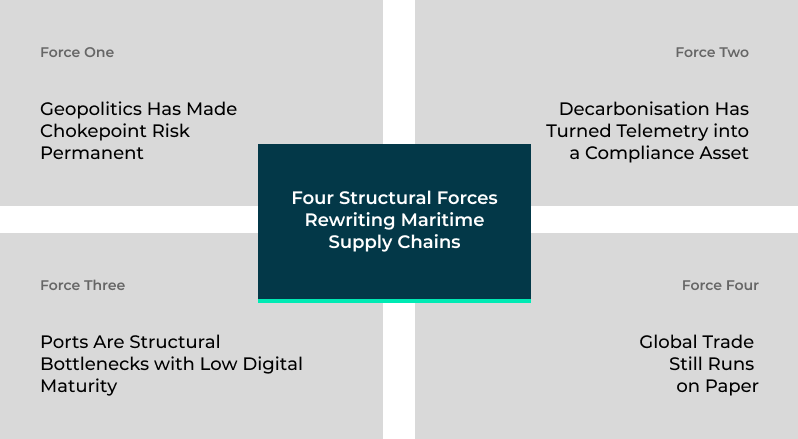
Force 1 — Geopolitics Has Made Chokepoint Risk Permanent
Average haul distances increased from 4,831 miles (2018) to 5,245 miles (2024) as vessels reroute around conflict zones
The Red Sea, Suez Canal, Black Sea, and Panama Canal now experience persistent — not episodic — disruption
These shocks reshape freight flows, trade costs, and emissions
Maritime routing has shifted from an operational decision to a macro-economic variable.
Implication
Real-time, risk-aware route intelligence becomes foundational.
Force 2 — Decarbonisation Has Turned Telemetry into a Compliance Asset
IMO targets a 40% carbon-intensity reduction by 2030 (vs 2008)
Shipping is now included in the EU Emissions Trading System
FuelEU Maritime enforces lifecycle GHG rules
Compliance could raise logistics costs 3–7.6% by 2030 without optimisation
Implication
Every vessel becomes a real-time data generator.
Telemetry must be converted into actionable emissions intelligence.
Force 3 — Ports Are Structural Bottlenecks with Low Digital Maturity
~90% of global trade by volume passes through seaports
Port Community Systems remain unevenly adopted
Coordination still relies on phone calls, email, and siloed systems
Implication
Efficiency, resilience, and decarbonisation are impossible without shared digital coordination layers.
Force 4 — Global Trade Still Runs on Paper
Bills of Lading account for 10–30% of documentation cost
Digitalisation could unlock $6.5B in direct savings and $30–40B in new trade annually
Only ~2% of container BoLs were electronic as recently as 2022
Implication
Documentation, compliance, and traceability are becoming core digital infrastructure.
From Structural Pressure to Platform Opportunity
Taken together, these four forces do more than increase complexity — they break the existing operating model.
They cannot be solved by scale, steel, or incremental optimisation.
They require a new layer of intelligence that sits above ships, ports, and logistics assets, coordinating decisions across fragmented stakeholders in real time.
When constraints shift from physical to informational, platform economics follow.
The result is not one monolithic system, but a small number of distinct problem spaces — each with clear buyers, regulatory drivers, data cores, and the potential for network effects.
These are the zones where billion-dollar technology platforms can now be built.
2. Six Structural Opportunity Zones
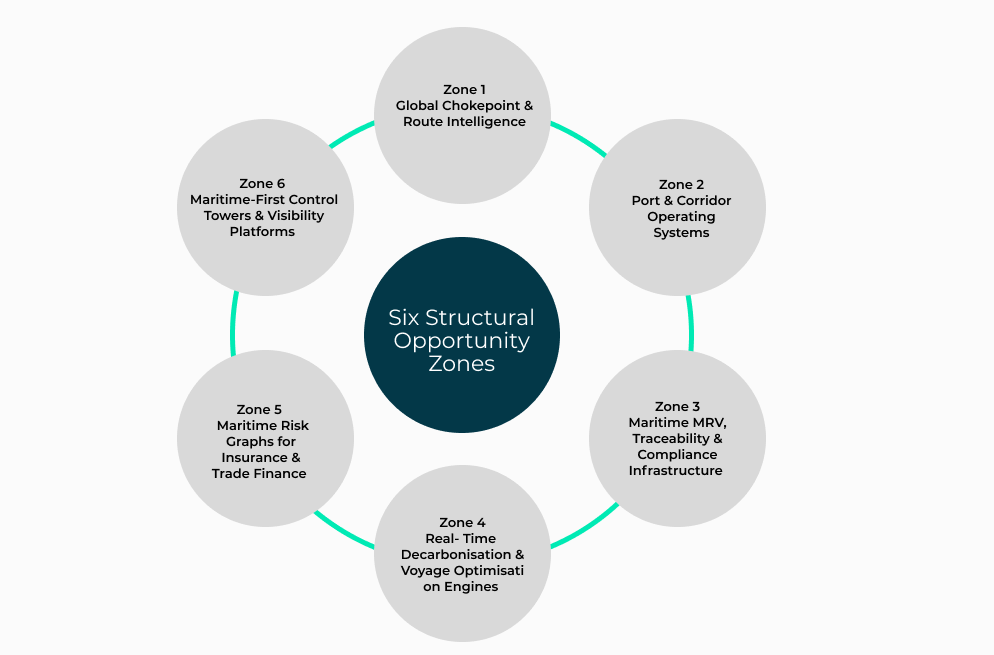
Zone 1 — Global Chokepoint & Route Intelligence
The Bloomberg Terminal for Maritime Macro-Risk
What companies will build
Real-time chokepoint risk indices
Predictive routing and ETA models
Multi-scenario simulations (cost, time, emissions)
APIs for insurers, lenders, shippers, and governments
Why it’s inevitable
Permanent volatility makes exposure-adjusted routing non-optional.
Zone 2 — Port & Corridor Operating Systems
The OS for the World’s Most Critical Trade Nodes
What companies will build
Corridor-level visibility across vessel, yard, and hinterland
Integrated port-call and berth optimisation
Carbon- and delay-minimising scheduling
Real-time public-private collaboration layers
Why it’s inevitable
Ports cannot modernise or decarbonise without shared digital infrastructure.
Zone 3 — Maritime MRV, Traceability & Compliance Infrastructure
The Digital Spine for Trade, Sanctions, and ESG
What companies will build
Electronic trade documentation and eBoLs
Embedded sanctions, KYC, and ESG lineage
Regulatory and customs interoperability
Multi-jurisdiction digital trade corridors
Why it’s inevitable
Trade cannot scale without digital trust.
Zone 4 — Real-Time Decarbonisation & Voyage Optimisation Engines
The Flight-Management System for Ships
What companies will build
Continuous MRV engines (EEXI, CII, EU ETS)
Weather- and draft-aware fuel optimisation
Carbon-liability forecasting
ESG-grade datasets
Why it’s inevitable
Climate compliance is now a real-time operational constraint.
Zone 5 — Maritime Risk Graphs for Insurance & Trade Finance
The Moody’s of Shipping Exposure
What companies will build
Entity graphs linking vessels, owners, cargo, and routes
Dark-activity detection
Compliance-adjusted risk scores
Portfolio stress-testing engines
Why it’s inevitable
Risk pricing is becoming data-driven — maritime is next.
Zone 6 — Maritime-First Control Towers & Visibility Platforms
The Missing Layer in Enterprise Supply Chains
What companies will build
Maritime-native ETA and disruption models
Port congestion and routing intelligence
Exception-management engines
Integrations with TMS, ERP, and multimodal platforms
Why it’s inevitable
Any control tower that cannot see the ocean leg clearly is incomplete.
3. Why These Zones Are Structural, Not Cyclical
Across regulation, geopolitics, climate policy, and financial markets, one conclusion repeats:
Modern global trade cannot function without real-time digital intelligence.
There is no market cycle in which these pressures disappear.
4. What Winning Companies Will Look Like
Winning platforms will be:
Data-dense and multi-source
Ecosystem-neutral
Regulatory-grade by design
Built with network-effect flywheels
Focused on narrow wedges with global expansion paths
Monetised across shipping, logistics, finance, and government
5. The Window Is Open
The forces are locked in.
The market is early.
The intelligence layer remains largely unclaimed.
This creates a five-year window (2025–2030) to build:
Durable data moats
Deep industry integration
High-margin, infrastructure-like technology platforms
This future is not uncertain.
It is already written in the structure of global trade.
The only question is who will build the intelligence systems that power it.