
Where Will Future Wealth Be Created?
New research among Family Office CIOs suggests the next decade of wealth creation may be shaped less by identifying winning companies and more by understanding where value is moving.
Investors have never had access to more information.
Markets are more transparent. Data is more abundant. Research is more accessible. Artificial intelligence can analyze entire industries in seconds. Yet despite this unprecedented access to information, many investors believe identifying future opportunities is becoming harder rather than easier.
That tension sits at the heart of a recent study conducted by Investigate VC exploring how Family Office CIOs think about future wealth creation.
The findings revealed a striking paradox. While information has never been more abundant, 31% of CIOs identified separating signal from noise as their single biggest investment challenge. At the same time, 83% believe intelligence is becoming more important than capital in identifying future opportunities.
As one CIO observed:
"The challenge isn't finding information. The challenge is deciding which information deserves our attention."
Taken together, these findings suggest that something more fundamental may be changing. Many investors are no longer focused solely on identifying the best companies. They are trying to understand where value is moving.
What Family Office CIOs Are Seeing
The study revealed a strong level of consensus around several themes shaping the future of investing.
83% of CIOs believe intelligence is becoming more important than capital in identifying future opportunities. 80% believe industry transformation is becoming more important than company selection. And 93% consider sector expertise critical when selecting investment managers.
The same pattern appears when CIOs were asked which factors are most likely to create outsized enterprise value over the coming decade. The highest-ranked drivers were network effects, proprietary data, ecosystem position, AI advantage and distribution advantage.
What is striking is that these are not traditional measures of company strength. They are structural advantages. They describe how value moves through an industry rather than how a single participant performs within it. This may help explain why many Family Office CIOs are beginning to look beyond individual companies and focus more closely on the systems in which those companies operate.
Looking Beyond Today's Winners
For decades, investment analysis largely began with the company: Which management team is strongest? Which business has the best product? Which company is taking market share?
These questions remain important. But they often assume that the structure of the market itself remains relatively stable. Increasingly, that assumption no longer holds.
Artificial intelligence, platform economics, changing customer behaviour and new business models are reshaping entire industries simultaneously.
As one CIO put it:
"We spend less time asking which company will win and more time asking which industry economics are changing."
This perspective helps explain why 80% of CIOs believe industry transformation is becoming more important than company selection.
Industries change before companies win. Value moves before markets fully recognise it. And by the time the winning companies become obvious, much of the value has often already been captured.
The Rise Of Value Migration
At Investigate VC, we refer to this phenomenon as Value Migration.
The idea is straightforward. Future wealth creation rarely occurs where value resides today. It occurs where value is moving.
History provides countless examples. Value migrated from physical retail to e-commerce. From software licenses to software-as-a-service. From traditional media to digital platforms. From ownership to orchestration.
The businesses that generated extraordinary wealth during these transitions were often not simply better companies. They were positioned where value was moving.
The challenge for investors is recognizing similar migrations while they are still unfolding.
As one CIO noted:
"The biggest opportunities often emerge before there is an obvious winner. By then, the migration has already begun."
Our research suggests that several shifts are particularly relevant today.
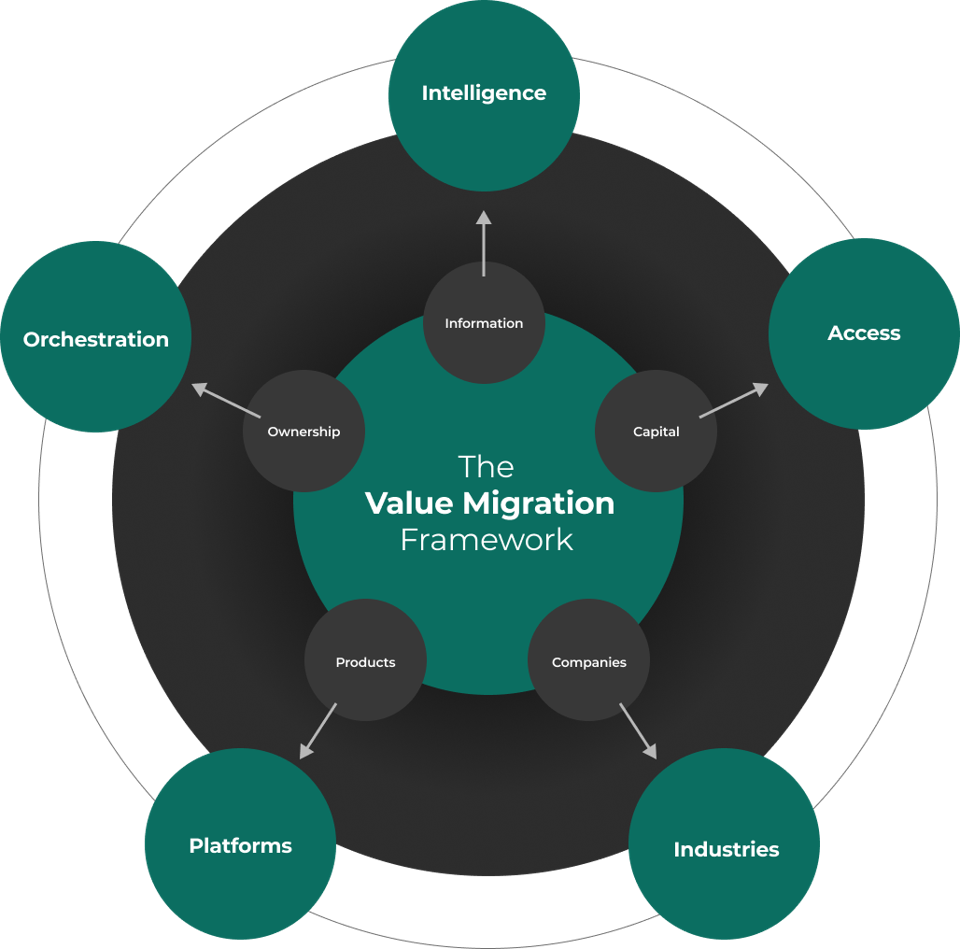
Information is becoming abundant, making intelligence more valuable. Capital is becoming more available, making access increasingly important. Investors are looking beyond companies and focusing more on industry transformation. Products are giving way to platforms, ecosystems and networks. Ownership is increasingly being complemented by orchestration and influence.
While these shifts may appear unrelated, they all point toward the same underlying reality.
Value is moving. And wealth tends to follow.
Why This Matters For Family Offices
Family Offices occupy a unique position within the investment ecosystem.
Unlike many institutional investors, they are often able to think across decades rather than quarters. They can explore emerging themes before they become consensus and build conviction before opportunities become crowded. That flexibility becomes increasingly valuable during periods of structural change.
As one CIO explained:
"Capital gets companies started. Access determines how far they go."
This is an important distinction. Capital remains essential. But as capital becomes more abundant, access, expertise and intelligence increasingly become differentiating assets.
The risk is no longer a lack of information. The risk is being positioned where value is leaving rather than where value is arriving.
Three Questions Every Family Office Should Be Asking
A key conclusion from this study is that future wealth creation is becoming increasingly tied to understanding change.
That raises three questions every Family Office should be asking.
Are we investing in today's winners or tomorrow's value pools?
Most investment processes are designed to identify strong companies and attractive assets. The challenge is that many of the biggest opportunities emerge before the winners become obvious. By the time markets reach consensus, much of the value has already been captured.
Where is value moving within the industries we know best?
Every Family Office has areas of deep expertise. The question is not whether those industries will survive, but how value within them is being redistributed. New technologies, business models and ecosystem dynamics are creating new positions of advantage while weakening others.
Importantly, the forces reshaping an industry do not always originate from within it. Some of the most transformative innovations begin in one sector before migrating into another. AI developed in technology is now reshaping healthcare, financial services and professional services. Software transformed retail before influencing logistics, manufacturing and transportation.
Increasingly, investors need to look beyond industry boundaries and ask not only what is changing within a sector, but what is coming toward it.
What is our intelligence advantage?
Capital is abundant. Information is abundant. What remains scarce is interpretation. How does your organization identify meaningful change, separate signal from noise and build conviction before consensus forms?
Future Wealth Creation Requires a New Approach
Taken together, these questions point to a broader shift in how investment advantage is created. Future success may depend less on identifying the strongest company within an existing market and more on understanding how industries are evolving, where value is migrating and which new positions of advantage are emerging.
For Family Offices, this changes the investment challenge. Rather than trying to predict which individual company will dominate a sector, the objective is to identify where structural change is creating entirely new value pools. That requires developing deep industry expertise, building access to the entrepreneurs, investors and ecosystems shaping those industries, and looking beyond traditional venture hubs to identify innovation wherever it emerges.
Increasingly, the forces transforming an industry originate outside it. Artificial intelligence developed within technology is reshaping healthcare, financial services and manufacturing. Advances in robotics are influencing logistics, agriculture and industrial production. Future opportunities will often emerge where technologies migrate across industries rather than within established market boundaries.
That reality requires a different approach. One that combines human judgement with AI-powered intelligence. One that identifies structural change before it becomes consensus. And one that builds access to the founders and ecosystems where future value is being created.
After all, future wealth follows future value creation. The challenge is not predicting the future with certainty. It is recognizing where value is moving before everyone else does.
About The Study
This article draws on findings from The Future Wealth Creation Study 2026, a global research initiative conducted by Investigate VC exploring how Family Office CIOs think about future wealth creation.
The study was conducted using a panel of 1,000 AI-generated Family Office CIO profiles designed to reflect the diversity of the global Family Office ecosystem across geographies, investment styles, sizes and wealth origins.
This approach, often referred to as synthetic research, uses advanced AI models to simulate how specific groups of decision-makers may evaluate opportunities, risks and future scenarios.
About The Author
Kasper Ulf Nielsen is Co-Founder of Investigate VC and leads the firm's research into future wealth creation. The research behind this article reflects how Investigate VC approaches investing. The firm combines proprietary AI research with access to global startup ecosystems, including Antler, to identify where value is moving before it becomes obvious. Investigate VC is currently raising a $150 million venture fund focused on backing founders at the intersection of industry transformation and future value creation.
